
Search Aurora Residents Directory
Aurora maintains separate portals for different types of residents directory records, making it important to understand which system holds the information you need. The city spans three counties with Arapahoe County as the primary jurisdiction. General city records go through one online portal, police records through another, and court records require email requests. Police records and court records have separate request portals, each with its own submission process and tracking system. NextRequest allows requesters to track status of their submissions in real time. This setup means you may need to check multiple places depending on what you are looking for, but it also means each department can respond faster because requests are routed directly to the right staff.
Aurora Quick Facts
General City Records Portal
The Aurora public records portal handles most city department records. This includes building permits, city council minutes, planning documents, and general administrative files. You can submit requests online and track their progress from start to finish.
The portal shown below lets you create an account or submit requests as a guest. Having an account makes it easier to check back later and see updates.
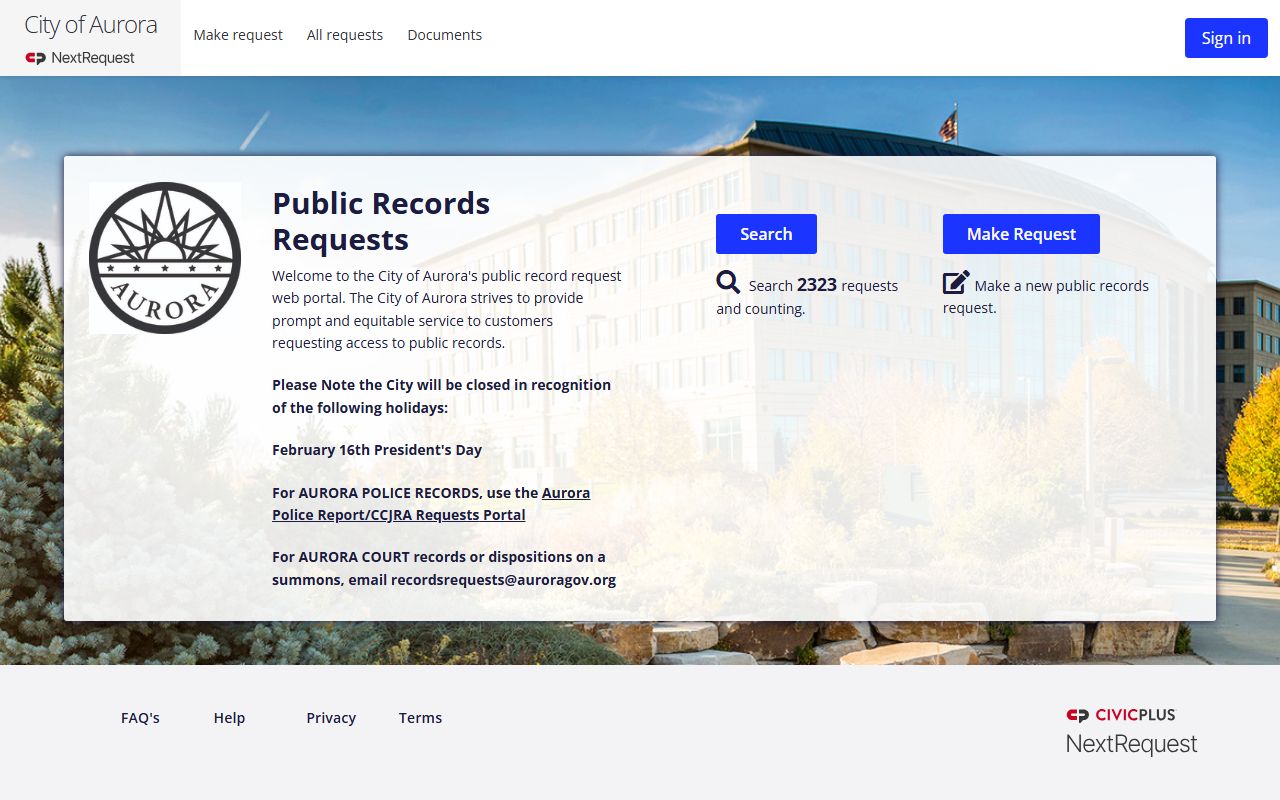
Once you submit a request, the system assigns it a tracking number. You can log in any time to see if the request is still being reviewed, if staff have questions, or if your records are ready. This transparency helps people plan. If you need the records by a certain date, you can see whether that will be possible.
Most requests get answered within three business days. Complex searches may take longer. The system will notify you if additional time is needed. You can also see if there are any fees before you agree to pay for copies.
Police Records System
Aurora police records require a separate portal. Visit the police records request site to ask for incident reports, accident reports, or other law enforcement documents.
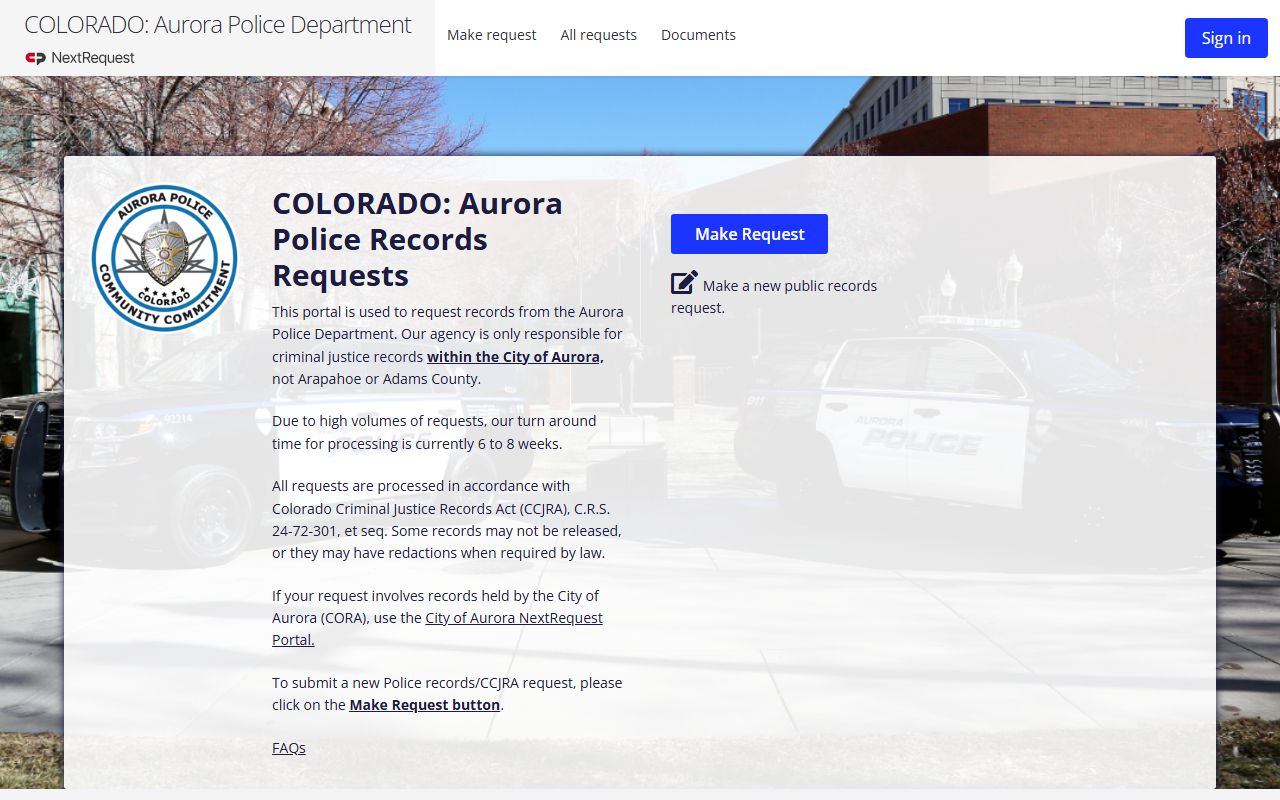
Police records often take a bit longer to process because staff must review each report for information that cannot be released. Active investigations, victim identities, and certain tactical details stay confidential. The department redacts these parts before releasing the rest of the report.
You can request records by case number, date, location, or involved party name. The more details you provide, the easier it is for staff to locate the right report. If you were involved in an incident, mention that in your request. Some records are easier to get if you are a party to the case.
Note: Police records and court records have separate request portals, so check which system holds the information you need before submitting.
Court Records Requests
Aurora municipal court records must be requested by email. Send your request to recordsrequests@auroragov.org with details about the case or document you need. Include the case number if you have it, along with the names of parties involved and approximate dates.
Court staff process these emails during regular business hours. You will get a reply within the standard CORA timeframe. The reply will tell you if the records are available, what the cost is, and how you can get copies. Some court records are sealed by order of a judge. If that applies to your case, the court will explain why it cannot release the file.
Certified copies of court judgments or orders cost extra. The city follows C.R.S. §§ 24-72-301 through 309 for criminal justice records. Chief Justice Directive 05-01 also applies, setting rules for what case information Colorado courts must make public. These laws protect sensitive data while ensuring people can access information they need for legal purposes.
How Aurora Spans Three Counties
Aurora is one of the few Colorado cities that crosses county lines. The largest portion sits in Arapahoe County. Smaller sections fall within Adams County and Douglas County. This matters because some records are held by the county, not the city.
The Arapahoe County Clerk and Recorder maintains property deeds, marriage licenses, and other vital records for the main part of Aurora. If you need records from the Adams or Douglas portions, you would contact those counties instead.
City records are managed by Aurora regardless of which county the property or incident falls in. County records follow county boundaries. So if you need both city and county information, you might be dealing with multiple offices. This can feel confusing at first, but each office has staff who can direct you to the right place if you call and explain what you need.
Tracking Your Request
NextRequest allows requesters to track status in a way that older systems did not. You can see when your request was opened, who is working on it, and what stage it is in. This reduces the need to call and check on progress, which saves time for both you and city staff.
If staff have a question about your request, they can message you through the portal. You will get an email alert and can log in to respond. This back-and-forth happens much faster than mailing letters or playing phone tag. Many requests that used to take a week now finish in three days because of this improved communication.
You can also upload additional information if you realize you left something out of your original request. For example, if you forgot to mention a second address, you can add that detail through the portal without starting over.
Note: Creating an account in the NextRequest system makes it easier to track multiple requests and receive updates automatically.
Understanding CORA in Aurora
C.R.S. §§ 24-72-200.1 through 205 set the basic rules for public records in Colorado. These statutes say that most government records are open unless a specific law makes them confidential. The city must respond to your request within three days. If that is not possible, they must tell you why and give you an estimated date.
Some types of records are always private. This includes personnel files, certain financial data, and records involving children. If you ask for a record that is not public, the city will cite the law that protects it. You can appeal that decision if you think the city is wrong.
Most people do not need to appeal. The majority of requests result in full or partial release. Partial release means some parts are redacted to protect private information, but the rest is given to you. For example, a contract might have one person's social security number blacked out, but the rest of the document is readable.
City Website Resources
The main Aurora city website links to all the portals and provides contact information for every department. Use it as a starting point when you are not sure where to go. The site has a search function that can help you find the right page quickly.
Many departments post commonly requested documents directly on their pages. Meeting agendas, budget reports, and annual statistics are often available for download without a formal request. Checking the website first can save you time if the information you need is already online.
The website also lists office hours, phone numbers, and physical addresses. If you prefer to submit a request in person, you can find out where to go and when the office is open. Some people like to talk to staff face-to-face, especially for complicated requests.
Arapahoe County Residents Directory
Because the bulk of Aurora sits within Arapahoe County, many residents directory searches will also involve county records. The county clerk maintains property records, court filings, and vital records that the city does not handle. For complete information on county-level searches, visit the Arapahoe County page.
Nearby Colorado Cities
Several other large cities are close to Aurora. Each has its own records system and procedures. If you need information from more than one city, you must submit separate requests to each. Cities do not automatically share records with each other.